
Home / Resources / Staffing & training
STAFFING & TRAINING
EEG technician training: who can run an EEG-based assessment in your practice
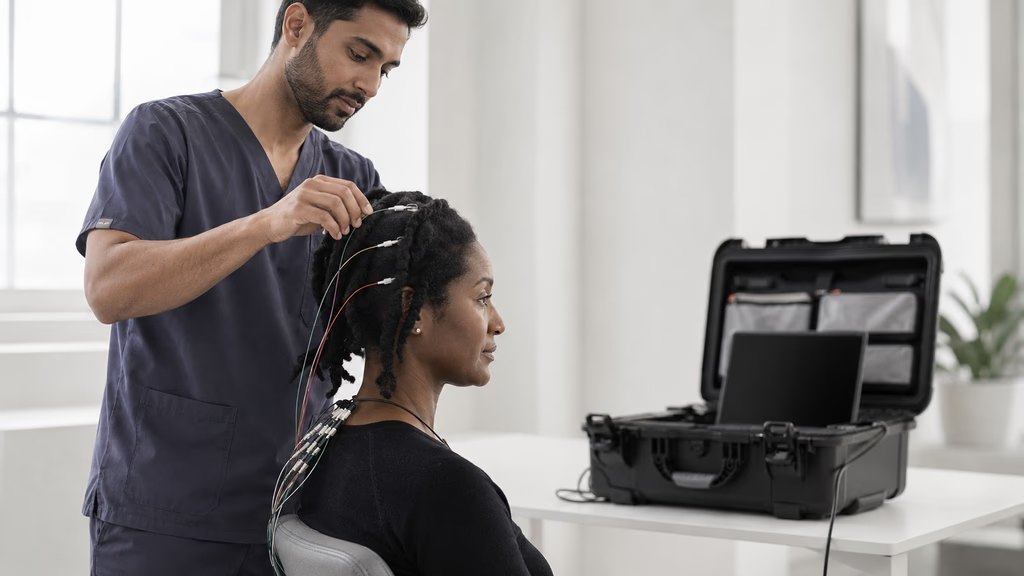
Most results for “EEG technician training” are career programs. If you run a practice, you need to know who on your team can collect EEG data, what training they need, and who interprets it. There are two routes. Hire or credential a registered EEG technologist, or train existing staff on a specific assessment system. For a VoxNeuro cfNI assessment, VoxNeuro trains your existing staff and a qualified clinician interprets the report.
THE SHORT ANSWER
- A registered EEG technologist (ABRET’s R. EEG T.) qualifies through one of four pathways, passes a two-section exam and holds the credential for 5 years (source).
- The national average pay for an EEG technologist is $73,166 a year, about $35 an hour (source).
- A VoxNeuro cfNI assessment is run by your existing staff after VoxNeuro operator training. The software analyzes the data and generates the report. Your clinician interprets it.
- Operator and interpretation training are part of the one-time setup and training fee.
- cfNI is prescription-use software for adults 18 to 70. It does not provide a diagnosis or clinical interpretation.
Who does what in an EEG-based assessment
Any EEG-based service has three jobs: collecting the data, analyzing it, and interpreting the result for the patient. In a conventional EEG lab a technologist collects, and a physician does both analysis and interpretation by reading the recording. In a cfNI assessment the split is different.
YOUR STAFF
Collect the data
A 20–30 minute assessment, five tasks, after VoxNeuro operator training
cfNI SOFTWARE
Analyze and report
Compares EEG/ERP measurements with a reference database and generates the report
YOUR CLINICIAN
Interpret
Reviews the report alongside their own evaluation
The cfNI workflow. VoxNeuro trains your staff to run the assessment; cfNI analyzes the data and automatically generates the report for your clinician to review.
Route one: a registered EEG technologist
The R. EEG T. credential from ABRET is the standard registration for EEG technologists in the United States. The 2026 candidate handbook sets four eligibility pathways (source).
| Pathway | Education | Experience and documentation | Also required |
|---|---|---|---|
| I CAAHEP-accredited program | Graduate of an accredited neurodiagnostic program | 50 documented EEGs | Current CPR/BLS |
| II Non-CAAHEP formal program | Certificate of completion from an ABRET-recognized program | 100 documented EEGs | Current CPR/BLS |
| III Associate degree or RPSGT | Associate degree or higher, or a current RPSGT | 1 year of clinical EEG experience; 150 EEGs documented after that year; 60 EEG-related ASET CEUs | Current CPR/BLS; measurement assessment document |
| IV Practice track | High school diploma or GED | 5 years of clinical EEG experience; 150 EEGs documented after the first year; 120 EEG-related ASET CEUs | Current CPR/BLS; measurement assessment document |
ABRET defines clinical EEG experience as 32 hours a week, 1,664 hours a year. Sleep experience does not count toward it.
The exam has two sections of 120 minutes each. The credential is awarded for 5 years and then recertified. A practice that hires a registered technologist is buying that training history, and pays for it. The middle half of EEG technologist salaries runs from $61,884 to $82,345 a year (source).
State licensing is a separate question. One staffing-firm certification guide reports that EEG work carries no state licensing requirement, while ten states license polysomnography (source). Confirm that with your state before you rely on it; scope-of-practice rules for the staff who touch a patient are set at the state level.
When hiring a registered technologist is the right call
- You’re building a full EEG lab that will run routine and extended studies a physician reads.
- You plan long-term monitoring, where the 95700 to 95726 code set and its documentation rules apply (billing guide).
- You intend to bill digital analysis under 95957, which a public guideline describes as an extra hour of technician processing plus 20 to 30 minutes of physician review per recording.
- You have a reading physician on staff and the volume to keep both of them busy.
In those cases you are staffing a lab and need the registered credential. For a defined assessment that software analyzes, the operator collects data and does not read it, so the requirement is different.
Route two: train your existing staff on a defined assessment
VoxNeuro trains your staff to run the assessment. cfNI analyzes the data and automatically generates the report for your clinician to review. The operator’s job is to collect good data: prepare the patient, place the electrodes, and run the 20–30 minute assessment. The five tasks are resting state, an auditory oddball task, a Go / No-Go task, a visual memory task and a flanker task. Included operator training prepares your team for that.
Interpretation stays with a qualified clinician. The report compares the patient’s EEG/ERP measurements with age-matched reference scores; your clinician reviews it alongside their own evaluation. Interpretation training is included. cfNI is FDA-cleared, prescription-use software indicated for adults 18 to 70, and it does not provide a diagnosis or clinical interpretation.
All technician and physician training is included, and the VoxNeuro team member who runs your training supports day-to-day questions after launch. In imaging departments, who may be trained as an operator is subject to site requirements; the diagnostic imaging page covers that.
Our data
The minimum prerequisites for each route, from the ABRET 2026 handbook (source) and VoxNeuro’s program facts. Experience requirements are converted to hours with ABRET’s definition of clinical experience: 32 hours a week, 1,664 hours a year (source). The routes lead to different work. A registered technologist runs routine and extended EEG studies, and a VoxNeuro-trained operator runs the cfNI assessment.
| Route | Minimum prerequisites | Minimum clinical EEG hours before eligibility |
|---|---|---|
| ABRET Pathway I | Accredited program graduate, 50 EEGs, CPR/BLS | Program length; no hours rule |
| ABRET Pathway II | ABRET-recognized program certificate, 100 EEGs, CPR/BLS | Program length; no hours rule |
| ABRET Pathway III | Associate degree or RPSGT, 1 year clinical EEG, 150 EEGs, 60 CEUs, CPR/BLS, measurement assessment | 1,664 |
| ABRET Pathway IV | High school or GED, 5 years clinical EEG, 150 EEGs, 120 CEUs, CPR/BLS, measurement assessment | 8,320 |
| VoxNeuro operator | Existing staff member; VoxNeuro operator training, included in the setup and training fee | Training typically begins within two weeks of signing |
The hours column is the arithmetic of ABRET’s definition, not a claim about how long a given person takes. Pathways I and II depend on program length, which varies by school.
A decision framework
- What will the service be? A full EEG lab points to route one. A defined, software-analyzed assessment points to route two.
- Who interprets? Both routes need a qualified clinician. Decide who that is before you decide who collects.
- What does your state allow? Check scope-of-practice rules for the staff you plan to train, and site requirements if you’re in an imaging department.
- What does the hour cost? A registered technologist averages $35 an hour in salary alone (source). Compare that with the time your existing staff would spend per 20–30 minute assessment.
- How fast do you need to start? Pathways III and IV take one to five years of clinical experience, and Pathways I and II take a program; VoxNeuro training and implementation can typically begin within two weeks.
Limitations
We don’t publish the hour count of VoxNeuro operator training here; it’s delivered per site and our team will tell you what your schedule looks like. The ABRET figures are from the 2026 handbook and change with each edition. Salary data is a national average as of November 1, 2026. State rules are not summarized here; ask your state board. For what the service costs, see what an EEG machine costs; for coding, the EEG CPT codes guide.
FAQ
Does my practice need a registered EEG technologist to offer a cfNI assessment?
VoxNeuro trains your existing staff to run the assessment, and a qualified clinician interprets the report. Whether your state or your site imposes further requirements on who may collect the data is a question for your state board and, in imaging departments, your site.
Who can interpret a cfNI report?
A qualified healthcare professional. cfNI is prescription-use software and the report is intended to support, not replace, that professional’s interpretation. Interpretation training is included.
How long does it take to become a registered EEG technologist?
It depends on the pathway. Pathway III requires 1 year of clinical EEG experience plus 150 documented EEGs and 60 CEUs; Pathway IV requires 5 years. Pathways I and II run through an accredited or ABRET-recognized program, then the exam.
How quickly can my staff be trained?
Training and implementation can typically begin within two weeks, with all technician and physician training included. Given current demand, we encourage practices to connect with our team early to lock in a start date.
Sources
- ABRET, R. EEG T. Candidate Handbook 2026: eligibility chart (Pathways I to IV), clinical experience definition, exam format and credential term. abret.org (PDF). Observed November 6, 2026.
- EEG Technologist salary, United States: average $73,166 a year ($35 an hour); 25th to 75th percentile $61,884 to $82,345. salary.com, as of November 1, 2026.
- Neurodiagnostic technologist certification guide (state licensing statement). trustedhealth.com. Observed November 6, 2026.
- VoxNeuro product and program facts: voxneuro.com (how it works, tasks, training, pricing model) and About VoxNeuro (FDA clearance 510(k) K253015, quality certifications).
See what adding VoxNeuro involves.
Operator and interpretation training are included in the one-time setup and training fee.